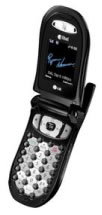
 After seeing Digit Wireless announce the Fastap keyboard announced a couple of years ago, I was delighted to see it recently enter the US market, as an OEM component in the featured and affordable LG AX490. The Fastap keyboard features raised buttons at the junctions of the number keys, essentially cramming a full alphanumeric keyset on the space normally reserved for the cannonical 10, hash and splat.
I currently use a Blackberry QWERTY thumboard to compose e-mail and send the occassional SMS while I'm away from my desk. In fact I find it more convenient to pen a paragraph poolside than bother retreating indoors to use a 64-bit electricity sink (with 101-key keyboard) to do the same, at a net loss of time. Still, tapping out the 7 key a full seven times to achieve a capital S is a non-starter for me, especially when I need a fully-functional Backspace key to accomplish anything marginally resembling correct spelling. (Before you ask about iTap, you should know I'm a lost cause. My fingers have known nothing but QWERTY since we had a leased rotary dial phone in the kitchen.) Even the introduction of the sleeker 7100 series, which looks like more phone than PDA, combines up to two alphas per key, gave me pause. Thank goodness the 8700 series retained a keyboard better suited for thumbs trained on rotary dialing.
That being said, a full thumboard seems synonymous with "more PDA than phone" profiles. One's arms can get tired on a long phone call. I'm anxious to get my hands on an LG AX490 and see if it works for me.
Q. Does the Fastap keyboard work for you?
Photo source: Digit Wireless
Friday, August 04, 2006
Fastap appears in LG AX490 Flip Phone

Friday, July 28, 2006
2G HTS Wire to Boost Capacity of Grid?
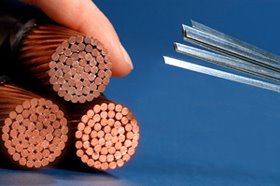 Tuesday's July 25th, 2006 Boston News Radio picked up American Superconductor's announcement of - if we were to believe the lead in - the panacea for an overloaded grid, preventing brownout conditions. The requisite sound bite from AMSC's Dr. Gregory Yurek reiterated the impact of this advance on preventing brownouts. I waited to hear what this silver (or perhaps copper-clad) bullet could be.
It's wire. Yes, wire, but not just any plain-old wire. This is second generation (2G) high temperature superconductor (HTS), a.k.a. 344 superconductors, being ultra thin (read: capable of high power density) and also 100% conductive at balmy liquid nitrogen temperatures. You won't be retro-wiring with this on your next kitchen remodel, but Mike Hervey of Long Island Power Authority (LIPA) is quoted as saying a length of it will be installed as a power transmission cable capable of carrying "600 megawatts of power - enough electricity to power 300,000 homes."
How long a length may be one issue. AMSC has demonstrated transmission of commercial levels of current over 300 feet, which is not quite enough to span even the most dense neighborhood of 300,000 row houses. How much cost may be another issue. One 2G HTS cable will replace 100 of its copper cousins, but it won't cost less. But AMSC has made the leap from the lab to the field, and predicts the cost of its 2G HTS wire will break even with copper by the end of the decade.
What about the brownouts? The key issue is the amazing power density of this stuff can more easily increase the grid capacity in highly congested power grids than conventional methods. Another side effect of their perfect conductivity (am I correct here?) is that their voltage stability limit must be near their capacity. Most 20th century cables are run at about half of their thermal limit. Drive them higher during peak demand times, and risk voltage instability. Keep it cool, and keep your voltage. So if ya wanna reduce brownouts, ya still gotta go build out the grid.
Q. To what degree do power outages affect your quality of life?
Photo source: American Superconductor.
Thursday, April 27, 2006
Free 411 info on call if you'll listen to ads
 Have I finally found a solution for the blatantly usurious fees charged by my mobile services provider? For that matter, by my landline POTS grifters as well? It seems if I'm willing to provide a few seconds of marketing eyeballs—or in this case ears—the answer seems to be a resounding yes.
USA Today reports on several no-charge "411" directory services. The round-up includes:
- 1-800-411-SAVE
- 1-800-FREE-411
- 1-800-411-METRO